SolanaCDN. Shreds, observable.
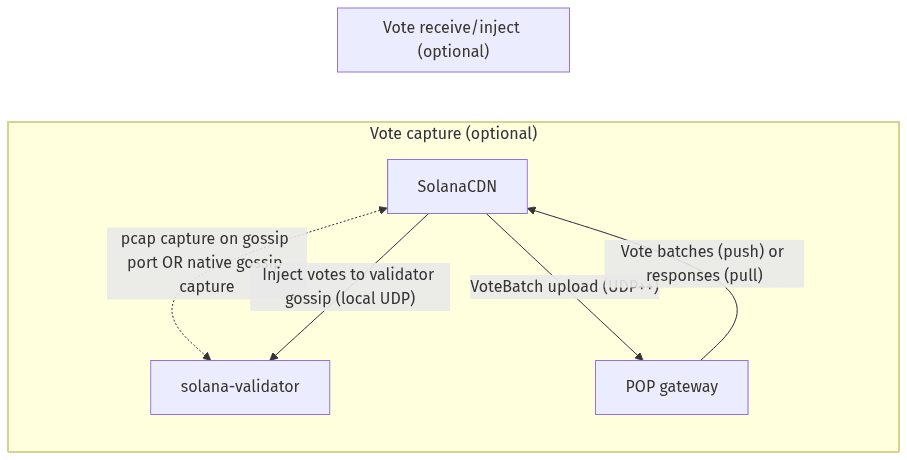
Improves vote propagation reliability and surfaces cluster activity in near real time. Optional shred mirroring for observability and diagnostics.
Opt-in and non-consensus. Integrated into an open-source Agave fork and can be disabled without affecting validator operation.
Practical Benefits
(Speed, Reliability, Global Coverage, Redundancy, Open Source)
Vote propagation reliability
Provides faster and more consistent vote relay paths, reducing propagation variance under load.
Telemetry & visibility
Earlier visibility into cluster voting activity and optional shred arrival timing.
Open-source integration
Integrated into an open-source Agave fork. Disable anytime and the validator continues.
Non-consensus by design
Does not modify consensus logic, leader scheduling, or voting rules.
Best-effort networking
All network operations are non-blocking and best-effort by design.
Fail-safe operation
If SolanaCDN is unavailable or disabled, validator operation is unaffected.
Resilience option (worst-case)
In extreme network stress, operators can tighten ingress to known SolanaCDN POPs and continue operating via the relay path.
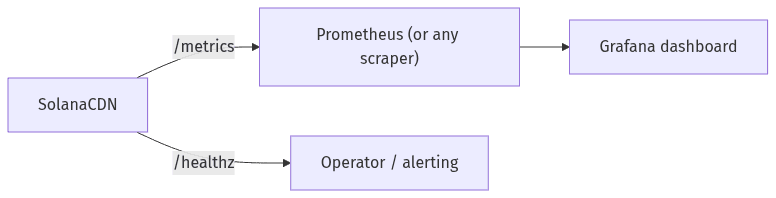
Metrics Dashboard
- Prometheus-compatible metrics for vote propagation and optional shred arrival timing.
- Earlier visibility into cluster activity and relay performance.
- Optional Grafana dashboard for quick visualization.
How it Works
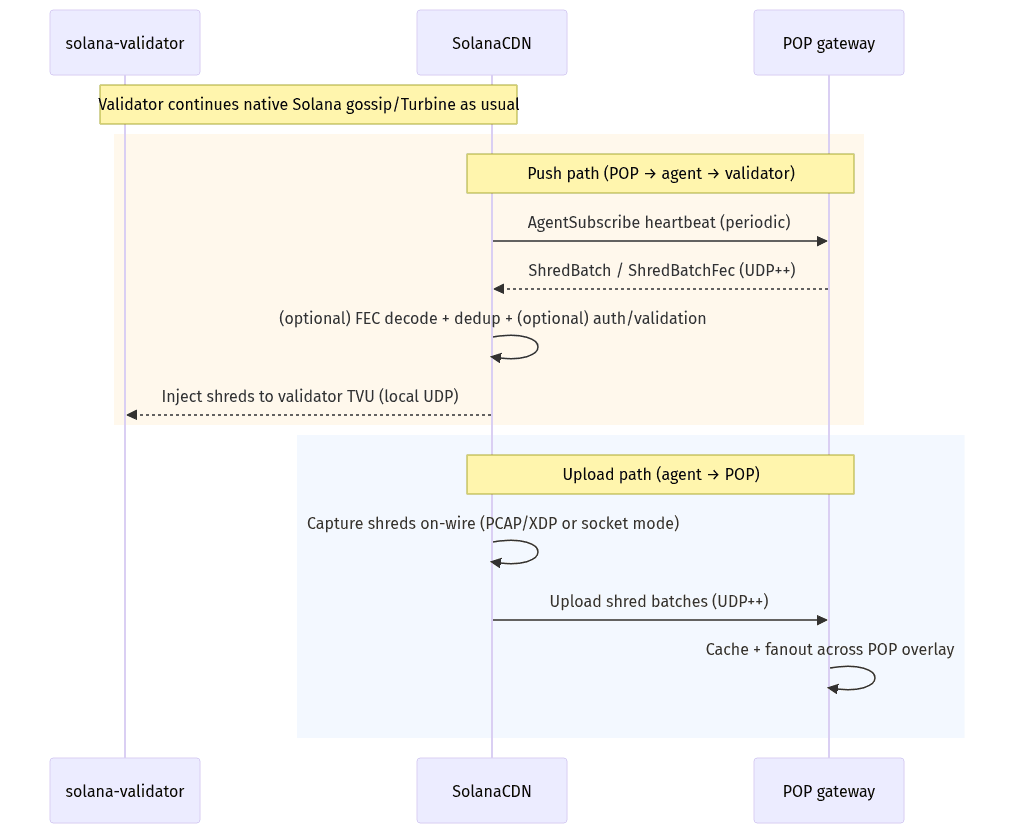
- Enable SolanaCDN in the open-source Agave fork (opt-in).
- Observe votes and optional shred reception (non-blocking).
- Relay signals to the nearest Pipe POP (best-effort).
- POPs aggregate telemetry for observability.
- Fail-safe by default — disable SolanaCDN and the validator runs normally.
Architecture Diagrams

When SolanaCDN Helps
When SolanaCDN Helps
- You want earlier visibility into vote propagation and cluster activity.
- You see propagation variance under network load.
- You want optional shred timing diagnostics without touching consensus.
When SolanaCDN doesn't help
- You already have low-variance propagation and don't need additional telemetry.
- You don't want to run the open-source Agave fork.
- You don't want optional shred mirroring or relay diagnostics.
Security & Resilience
Does SolanaCDN help during DDoS?
SolanaCDN isn't a DDoS product. In a worst-case event, validators can route through the SolanaCDN relay path and restrict ingress to known POPs to reduce public exposure.
Practical Guidance
- Enable or disable SolanaCDN independently without impacting validator operation.
- Select the POP closest to your hardware to reduce propagation variance.
- Prometheus-compatible metrics integrate with existing observability stacks.
- Optional last-resort posture: allow-list POPs and operate via the relay path.
- CPU capped (<1 core), ~100 MB RAM, +50 MB disk (typical).
Requirements
- Open-source Agave fork with SolanaCDN enabled.
- Mainnet compatible.
- Prometheus-compatible metrics endpoint.
- Optional shred mirroring bandwidth varies by mode.